
 he religious beliefs held by the people of the empire are
numerous, and few people can claim to know them all. There
are some deities who are worshipped by people from all walks
of life, as well as those followed by members of the various
breeds, and others who are served only by members of secret
sects unknown to their neighbours or even outlawed by the
Emperor himself. Gathering information about these faiths and
their gods is unsurprisingly a difficult task which has taken me
many years and is still a work in progress. Here is what
information Ive gathered, and I hope that it proves helpful
in navigating and understanding our webs of divine intrigue.
he religious beliefs held by the people of the empire are
numerous, and few people can claim to know them all. There
are some deities who are worshipped by people from all walks
of life, as well as those followed by members of the various
breeds, and others who are served only by members of secret
sects unknown to their neighbours or even outlawed by the
Emperor himself. Gathering information about these faiths and
their gods is unsurprisingly a difficult task which has taken me
many years and is still a work in progress. Here is what
information Ive gathered, and I hope that it proves helpful
in navigating and understanding our webs of divine intrigue.
The Deities of Blackfire
- Ashatem the Child of Darkness
- Aurgal the Devourer
- Bleskass
- Borudun the Benefactor
- Brem
- Cartoran The Time Keeper
- Caythilus God of the Forest
- Ekirek the Burning One
- Horned Rat King
- Ihrlesh the Victor
- Jerugal Queen of Maggots
- Kyroksh the Destroyer
- Kyzok Blood-Drinker
- Lassor Storm Lord
- Malishakan the Gatherer
- Melisande the Child of Light
- Morianna the Warrior
- Nynenve the Veiled one
- Syraskis the Lord of Treachery
- Tria the Mistress of Peace
- Vorlishar the Insane Master
Ashatem the Child of Darkness
Born of fire and son of Darkness, Ashatem is the most feared of all lesser deites. Driven by a insane need for flesh and blood, The Child of Darkness roams the forests throughout the Empire at night, hunting upon the occasional late traveller or the outskirts of of civilized areas.

His most common form is the shape of a strong black wolf with fiery eyes. He has also been known to socialize with mortals in the shape of a gaunt man dressed completely in black. Controlling his foul desires he then carefully picks out a victim whom he lures into the forest or a dark alley and feasts upon.
His name is told to scare children, whispered around campfires and used in dark rites. His followers are a secretive organization calling themselves 'The Pack'. They span the Empire, and are citizens who reveal their true nature at night. Then they meet and perform their insane rites, often smearing themselves in blood and hunting like wolves for flesh.
Worship of Ashatem is strictly forbidden, and the Empire executes swift judgement upon all those caught worshipping this deity. Ashatem rarely answer prayers, but does empower some of his most faithful servants. The cultists do not have any dress code and communicate only through a secret sign language. This way they can tell if a stranger is a true worshipper of Ashatem
Ashatem has sworn venegance upon the other dieties who once lured him into a trap where he was kept for centuries. With powerful magics they created a chain powerful enough to hold this beast. The chain was was fashioned out of six strange elements: the noise made by the footfall of a cat; the roots of a mountain; a woman's beard; the breath of fishes; the sinews of a bear; and a bird's spittle. With the smell of fresh pure blood they lured Ashatem deep underground and then chained him to a rock. Then they inserted a silver sword into his mouth to keep him from biting over the chain.
A magician named Rael managed to free The Child of Darkness in a unholy rite, and lost his soul in the process. Many a local claims to have seen Rael's haunting apparation hunting the woods at night, damned for eternity.
Aurgal the Devourer
Aurgal is a god who tempts mortals with the pleasures of the flesh. He loves to stoke the fires of lust, destroying reason and replacing it with uncontrolled passions and debauchery. He himself appears as a slenderly handsome Rakshasa with a cruelly sensuous smile, and dwells in a plane where he sits enthroned above hordes mindlessly lost in an orgiastic jumble of writhing flesh. Anyone condemned to his realm must endure an eternity of never satiated desire, where even the most painful and twisted tortures Aurgal can contrive are welcomed because they, at least, can make one feel for a brief while. In the midst of this sensual nightmare is an eternally ongoing feast, where the damned intermingle their couplings with a sickening excess of gluttony as they seek to fill their hunger in any way that they can.
The path that leads to an eternity in Aurgal's private hell is a slow one, but he and his mortal followers are masters of luring others to their downfall with their own innermost secret desires. He grants his chosen priests with power, but the price of this gift is that it is never enough, and any of them will do anything for just a little more.
Aurgal often disguises himself behind a veil, impersonating Nynenve the goddess of love, to better tempt mortals into doing his bidding.
Bleskass
A quiet diety in the Empire dedicated to healing the body and the spirit as well. Her followers are active but cannot openly appraise their belief in their lovely Goddess for the threat of death hangs over their heads. The Realm is slowing turning from the good dieties to the blood and lust of the dark Gods. But Bleskass is ever there for her followers protecting them with a might and strong determination that only the good of heart can understand.
But be not afraid of the evil and dark forces that try to split you apart, the Goddess of Healing will try her best to balance this destruction that has begun to infest the Empire. You need only to wear the cross of Bleskass and you will feel the warm glow within you when you fight the evil Gods and their minions.
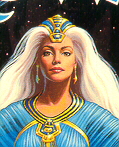
Bleskass's goodness and her healing powers have earned her a faithful following of believers. When she appears in her true form to her faithful, you can feel her passion for the pure of heart and then you understand her desire for the training of cleric's to roam the world and balance out the evil that is infesting it now. Her slender form is draped in a while silk gown, with her long white hair flowing loosely around her shoulders. Her emerald green eyes radiate a fire that can strike you in your heart with only a look.
Her father was A high cleric who fell in love with the Lady of the Lake, Asillia. He asked to raise their daughter in the healing arts, and Asillia taught her to love all creatures. Thus, Bleskass passed all the tests that were required of her with confidenence. Bleskass is stronger than her father ever was in her beliefs for she has looked long and hard into her own heart, and discovered a human fault. With this knowledge of herself, she knows she must be ever so careful not to fall victim to her own vanity. For in everyone there is an evil that lurks deep inside of each of us and the Goddess Bleskass fights hers everyday. Only the pure of heart who doubts themselves can wisely be truely worthy of title of Goddess of Healing.
She has been known to visit the populace in the Empire disguised as a ragged old beggar, roaming the streets and alleys searching for new members to join her. She is not afraid to face any of the other dieties, she knows in her heart she is important to the survival of the world, just as the evil dieties are, but they must maintain a balance or all we suffer.
Borudun the Benefactor
Borudun is a god whose name is often invoked, but few truly follow his path. He is the lord of generosity, and in these darkened times there are sadly few in the empire who care for generousness unless they are the recipients of it. Merchants say the name of Borudun loudly whilst swindling their customers, nobles praise him as they give mere pittances to help peasants survive, and it seems that many have their own interests at heart when invoking the Kind Lord. Still, there are a few who truly live the path of The Benefactor, and most are well loved by those who know them.
One exception to this sadly common truth is the halfling folk, for whom Borudun (named Borodun by them) is something of a patron deity to the race. When Borudun manifests to mortals, he often takes the shape of a wizened old halfling or gnome with a twinkle in his eye and a bag that is never empty of food and drink.
Borudun is also worshipped widely amongst beggars and thieves, and the former pray that he incline the more fortunate to aid them, while the latter claim their craft is Borudun's way of making sure wealth is spread around. What he might think of this, no one can know.
Brem
Brem is known to be the patron of Law and Justice. Those who worship him are most common among the ranks of guardsmen, sheriffs, and constables. It is said that Brem is the one that keeps the law among the gods. Bards claim to have seen Brem, traveling the land in the guise of a lone constable or judge, observing, and often offering his own opinions on subjects of law and justice.
He is portrayed as a tall, strong man, clothed in armor made of overlapping plates, with a long, deep blue cloak swirling behind him. Brem's supposed origin is documented in many children's songs and tales which speak of a brave warrior in the early days of the Empire. They say that this warrior traveled the length and the breadth of the Empire, and often, in areas far from the Emperor's seat of power, petty judges and sherriffs enforced whatever law they desired.
According to the stories, Brem was commissioned a judge, and he then removed the corrupt officials, and set up much of the system we see today. As Brem grew older, it is said that the gods themselves invited Brem to join them, which he accepted.
Cartoran The Time Keeper
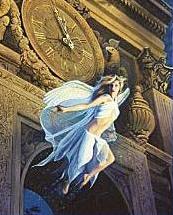
Cartoran is a popular deity among scholars, the educated and high society. He flows freely through the tides of time, merely watching and never mingling in the affairs of mortal men. He has been seen through the Empire, disguised as a beggar and traveling without destination.
He is usally portraited as an unnaturally tall blond male with curly hair and troubled eyes, often surrounded by a symbol for the flow of time like an clock or an old man.
Belief in him is more of a fashion than a need for empowerment, since he does not bestow any powers upon his followers, nor does he answer their prayers. A few cities have a small shrine dedicated to Cartoran and other lesser deities.
Some scholars says, contrary to common belief, that Cartoran is not a god of time, but a slave bound to journey through eternity. Once a normal man he used dark rites to twist the fabrics of time. This to gain immortality and the ablity to see in the future and the past. He was successful and will never die of old age. But his apprentice Antrmona betrayed his foul intentions to the gods. For his crimes they cursed him to travel endlessly through time without the ablity change the outcome. He has seen his own death and release at the hands of a warrior from a future past.6
Caythilus God of the Forest
Caythilus is a quiet god of the wild places, whose power is much reduced in the world. The devastation of the Chaos Wars which blighted much of the landscape of Blackfire has twisted many areas so far from their original nature that he no longer possesses any influence over them. The civilized peoples of the Empire consider his worship to be quaint and old-fashioned, and turn their backs on him to give praise to the Chaos Gods or those who oppose them, instead.
Caythilus himself cares little for the affairs of mankind as a whole, for there are many who have sought to exploit his power for their own ends. He concerns himself with the nurturing of what pristine wilderness remains, and looking after his chosen people. His followers are usually simple people, or students of the natural world. He is as likely to manifest as a sad old man or a virile stag.
Ekirek the Burning One
Ekirek is one of the old elemental gods of Blackfire, one of the few still worshipped since the days of the Chaos Wars. She is a fierce goddess of flame and fury, wholly disinterested in good or evil. Ekirek is renowned for her unpredictable rages, when she takes on the shape of a golden dragon wreathed in flame, and descends to bring fire and destruction upon the object of her tantrums. She also has her gentle moments, when she will protect and warm someone who has awakened her inexplicable pity.
Horned Rat King
No one truly knows much about the true nature of the Horned Rat King, the cult god of the evil skaven breed. Some believe that he is a powerful mortal skaven who has claimed godhood to ensure the loyalty of his minions, or even that 'the Horned Rat King' is a title inherited by a line of leaders among the rat people. Still others believe that he truly is one of the lesser Chaos Gods, who has sown this confusion over his identity either for entertainment or to keep the mortals guessing as his plans are made ready.
Regardless of who or what he is, the cult of the Horned Rat King is nearly unique among the evil sects in the Empire because his followers serve his purpose with fanatical devotion and work closely together as parts of some as yet unknown master plan. His worshippers are almost all skaven, and those who are not run the risk of being devoured by their fellows among the rat men. Whatever the secret agenda of the Horned Rat King may be, the world he uses his followers to create is a gruesome one. Victims are dismembered in his name, and any of his worshippers who shows signs of weakness are torn apart in bloody frenzies to ensure his continued blessings upon those who remain.
Ihrlesh the Victor
Ihrlesh is a god of strength and battle, but not one known for subtlety. He is a deity whose delights lie in glorious contests without much care for who may be in the right or wrong. When two champions meet face to face upon the field and duel to the death, Ihrlesh watches over them both and grants his favor to whomever wins. Nothing inspires the contempt of this god more than weakness and failure to take action, and his worshippers are inclined towards the use of straighforward strategy and force of numbers instead of devious or complex plans.
He always appears as a muscular minotaur with only one horn, and his worship is most common amongst that breed, who more commonly call him by the epithet of 'Uni' than by his proper name. However, he is also a favored god of knights and other soldiery who consider valor and glory the most important virtues of the battlefield. Ihrlesh is also invoked by many who hope that his blessing upon their wars might forestall the bloody interest of the Chaos Lord of battle, Kyroksh.
The symbol of Uni is the axe, and he will only grant powers and blessings upon those who prove themseves strong enough to be worthy. According to the legends surrounding him, he was once a mortal so consumed by his interest in the power of war that he devised weapons of incredible power to allow his allies unquestionable victory in war.
Jerugal Queen of Maggots
Jerugal is the goddess of pestilence and famine, and the mere utterance of her name is considered the filthiest of oaths. Icons in her likeness are destroyed in public festivals in an attempt to keep her power at bay and to mock her power, but nothing could ever truly strip her of her authority. Her worshippers practice in total secrecy, seeking to unleash disease and suffering, but they must exercise caution. Peasant mobs are more than happy to burn a priest of Jerugal instead of a crude icon at their festivals.
Jerugal appears as a gaunt, starved woman whose flesh is rotted and riddled with maggots and vermin, and her eyes are black pits filled with pinpricks of unwholesome green fire. She travels in style upon a chariot of bones, drawn by a horde of rotting human corpses that jerk and crawl grotesquely in their efforts to move the carriage of their mistress. When the White Chariot is seen abroad in the land, people scream and seek shelter, cowering behind closed doors.
Most of her followers practice the darkest arts of necromancy, learning magics of corruption and death. They consider anyone who practices necromancy for healing or to aid troubled spirits as the worst sort of heretic, and will torture them horribly at any chance. Jerugal is the sworn enemy of Bleskass.
Kyroksh the Destroyer
Kyroksh is the lord of battle, a Demon God of chaos and destruction. His invisible presence stalks battlefields, inciting bloodshed and meyhem wherever he treads. Those who seek the favor of the Destroyer try to impress him with their capacity for brutality, and by delving into the utter depths of depravity. No corruption of the flesh is beneath the interest of the Destroyer, and the more twisted or abominable these are, the better pleased he is. In the end, Kyroksh is said to prefer exquisite pain and a slow, horrible death to a quick, clean one, but it is the carnage of warfare that he loves the most. Ancient bindings prevent Kyroksh from having free reign on the mortal plane, and these are bonds he is eager to destroy.
Kyroksh appears as an unremarkable man, quite normal in all respects, save for the unholy flickers of flame in his eyes. Many myths tell of an unassuming warrior who came out of nowhere to offer good seeming advice and a skillful sword during a military campaign, yet later proved to be none other than Kyroksh himself. Often, the people whom Kyroksh assisted did indeed win their wars in the end, but only after terrible losses on all sides. The name of Kyroksh is spoken with fear or fanatical devotion: no one is ambivalent in their opinions of him. Although the Imperial armies have benefited from his power on more than one occasion, his worship is technically outlawed in the Empire. The corrupt generals and commanders of the Imperium will usually ignore this law, if the worship of Kyroksh can win them a victory.
It is said that once Kyroksh was betrayed by his most trusted assistant, a Demon Prince whose viciousness was only surpassed by his master's. The nature of this tale is twisted by many ages of retelling in the mouths of those who wish to either glorify the Demon God or turn the legend into a lesson in morality.
Kyzok Blood-Drinker
Kyzok, sometimes called simply the Blood God, finds many who offer lip service, but few who are devout worshippers. Kyzok's realm is slaughter and death, and he revels in needless bloodshed. He is one of the Chaos Gods, and therefore, those who do choose to worship him, do so in private. Kyzok does not bestow any known powers upon his followers, and does not answer prayers, however, blood sacrifices and large scale slaughter have been known to draw his divine attention.
The Blood God is commonly portrayd as a towering minotaur of massive proportions, with two large, curved horns growing from his scalp. Scholars argue the origin of Kyzok, some say that he was once a petty warlord, whose dreams of power took him far beyond the realm of men, though no one is sure.
Lassor Storm Lord
Lassor is one of the old elemental gods of Blackfire, one of the few who are still worshipped since the days of the Chaos Wars. His domain is the winds and oceans, and the power of storms. He is not a fashionable deity, like the tempting gods of Chaos or the few good gods whose worship endures, but there are many who would die rather than break faith with him. Nearly all sailors are worshippers of Lassor, and constantly strive for his favor lest he swallow them all beneath the sea.
The temperment of Lassor is volatile and swift to change, and he gives very little to his worshippers while demanding constant appeasement to keep his anger at bay. He appears most commonly as a gigantic titan of the oceans, or as a fierce, tentacled kraken.
Malishakan the Gatherer
Malishakan is the Lord of Greed, a covetous Chaos God whose primary purpose in existence seems to be the collection of everything he can acquire. Nothing is without value in the eyes of Malishakan, and his home plane is rumored to be an endless expanse of treasure and trash piled one atop the other into infinite space. One of his many epithets is 'Borudun's Shadow' and a common religious motif shows Malishakan trailing behind the generous god, snatching his gifts from the fingers of those who just received them.
Malishakan is a collector of more than merely physical wealth, and the sensations of the flesh delight him. His worshippers are often uncontrolled hedonists who pursue sensation and pleasure at any cost, while others are sadists who bring pain to others as a gift to their evil god. Malishakan may grant powers and worldly rewards to mortals who pray for them, but none of his gifts come without a price. The only way to receive a boon from the Gatherer is to bargain for it with him, and it is unheard of for him to not come out with the best of the bargain in the end. There is no treasure he values more than a mortal soul, and most of Malishakan's deals demand that his beneficiary sacrifice theirs for the object of their desire.
When Malishakan appears, he is always surrounded by the trappings of wealth and power. Ostentatious, even horribly gaudy, his affluence is enough to dazzle the eye. His voice is rich and smooth, and it takes a strong will to resist his persuasiveness.
Melisande the Child of Light
Melisande is one of the most beloved gods of the common folk of the Empire, and is known as the Child of Light, or Lady of the Dawn. She is the goddess of the sun and of the warmth that nurtures the world, and of the light which drives the darkness away with the coming day. With the growing popularity of the Gods of Chaos in the realm, the powerless commoners turn in increasing numbers towards Melisande, praying for her protection against the shadows that grow ever closer to their homes and hearths.
Melisande most frequently manifests herself to mortal kind at the moment of dawn, as a smiling young woman with golden yellow hair. At times, however, she has been known simply as a voice speaking from a patch of sunlight.
The powers granted by Melisande to her worshippers are few, but many who are good of heart have found her blessing upon them when they went forth to battle against the darkness. Her sacred swords are treasures much coveted by crusaders, who believe that a weapon blessed in the rites of the Dawnbringer will lend especial power and force to their battle against evil.
Morianna the Warrior
Morianna is an old goddess, long forgotten by most of the people of the Empire. Her worship is mainly restricted to peoples long isolated from the ebb and flow of civilization, although a few of her ancient shrines still attract the occasional devotee. She is a goddess of warriors, and of martial skill. Those few who do remember and worship her tend to be highly proficient in the use of weapons, or in the creation of weapons and armor.
Nynenve the Veiled one
It is said that once Nynenve was a goddess primarily of the elves, but many throughout the empire have come to worship her, for her domain lies in the hearts and loves of mankind. She is invoked at weddings and in the secret oaths of lovers, and legends say that she sometimes intervenes to protect those who fight adversity for the sake of their love. But like love itself, she is sometimes a hard goddess, forcing those who follow her to make difficult choices. She has been known to answer the prayers of spurned or jilted lovers who beg for revenge against the one who broke their hearts, and doesn't always act as the benevolent goddess that most assume her to be.
In addition to her interests in matters of love, Nynenve is a goddess of family and the home. Many households show a shrine to Nynenve somewhere near their hearth. It is said in legends that Nynenve will sometimes travel the world in mortal guise, asking hospitality of strangers. If she finds one of her shrines in their home in this way, she may be moved to bless her hosts with increased fertility or prosperity.
Nynenve is always depicted as a beautiful figured woman with her features concealed behind a flowing veil. Her worship ranges from ecstatic parties where the participants carouse until they drop, to quiet rituals of oaths and pledges. Even though she is worshipped throughout the Empire now, she is still especially loved by the Elves and Satyrs.
Syraskis the Lord of Treachery
Syraskis is a god whose worship is rarely admitted to where others can hear, for he is a lord of shadows and deceit. His followers call him Syraskis Life Bringer, in reference to a legend that he once took on the guise of a travelling physician who miraculously arrived on the doorstep of a family whose first child had just died of fever moments before. Using his godly powers disguised as medicine, Syraskis restored the infant to life and health and was praised and blessed by the happy family for the life of their son.
The twisted nature of Syraskis' blessing was revealed twenty years later, when the child restored by the 'Life Bringer' was a warrior in the army of a powerful lord. The young man who owed Syraskis his life betrayed his lord with a knife in the back, blaming the assassination upon a neighboring warlord instead. In the conflict, countless innocents died and the young man himself became a brutal ruler who instilled terror throughout his reign. Perversely, it was the Treacherous God who brought an end to his own chosen one's rule, betraying the brutal warlord by revealing his weaknesses to his many enemies.
Fickle Syraskis may be, but still this Chaos God finds no shortage of secret praises upon the lips of people in the Empire. From those who seek advantage by turning upon their allies, to those who think they are doing the right thing by betraying a wicked leader, Syraskis' influence will never fade away.
He grants many powers to his worshippers, but none can ever tell when they will fall out of his favor and have them taken away. Illusions and other mystic forces which trick the mind and eye are one of his favorite means of influencing reality. He usually appears as a handsome man, with a kind, trust inspiring look in his eye.
Tria the Mistress of Peace
Once a mortal healer by the name of Lenowyn, a name she is still called by some of her worshippers, Tria spent her mortal incarnation trying to negotiate between warring factions. She was so selfless and so caring that the good gods took notice of her acts, and made her one of their number. She is a goddess of diplomats and healers, who bestows her blessing upon those who seek to bring an end to strife and remedy the hurts of war. Those who worship her in this capacity in the present age are frequently considered weak and foolish, for it would take far more than an army of her devotees to persuade the forces of darkness to respect a balance of power and not seek more for themselves. Even those who fear the rising power of the Chaos Gods are more likely to turn towards a forceful deity like Melisande or Brem than to this unfashionable goddess.
As the Guardian of Eternal Peace, Tria's influence is harder to avoid. It is Tria who gathers up the spirits of the dead and guides them to their final rest. Because she will not take sides amongst the gods and risk disrupting the fragile illusion of peace among them, she alone is trusted to usher newly fallen souls to their eternal damnation or rewards. She manifests as either a featureless vision in a three-rayed crown, or as a minotaur with three horns.
Vorlishar the Insane Master
Vorlishar is the Lord of Chaos, and is arguably the greatest Chaos god of the Empire. His worship is strictly outlawed, but even amongst the civilized cities of Blackfire he has a strong following who practice his rites in secret and who strive to bring about a return of the powers of Chaos and anarchy to dominance in the realm. Outside of the enclaves of civilization, Vorlishar has a strong following amongst the evil races, who see the power of this dark deity as a means to gain their own ascendancy. The dark elves are particularly fond of the Mad God. Cults of Vorlishar are completely self serving, and almost never work together.
Vorlishar is completely insane, and wholly unpredictable. He typically does not grant powers or priveliges to those who invoke his name, but sometimes one of his worshippers develops vast abilities for destruction. The only thing that can be truly expected of Vorlishar is that he delights in destruction and the disruption of order. When he appears on the mortal plane, his semblance could be anything, but blight and decay follows where he treads. The plants he walks upon wither and die, buildings he touches crumble in an instant, and pure water touched by his shadow is made putrid and unclean.